


Validating transport tickets is just as crucial as purchasing them. While the M-Ticket allows for a 100% digital purchase, validation is what completes the journey. Without validation, there is no fair revenue distribution and no precise measurement of usage. Validation is the culmination of the process and an essential lever for reducing fraud, including unintentional fare evasion (when a passenger fails to validate their ticket without fraudulent intent), and for improving the reliability of usage data.
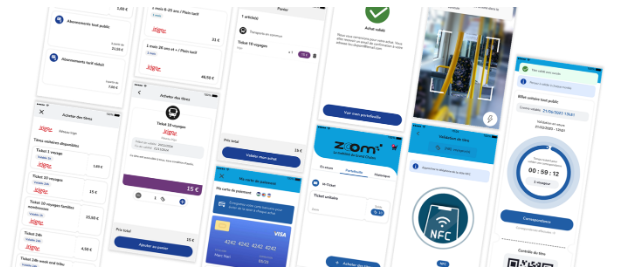
This article explains how M-Tickets work, the various validation methods available, and the associated challenges, particularly regarding passenger experience, data quality, and network operations.
1. What is an M-Ticket?
An M-Ticketis a digital transport ticket that passengers can purchase, store, and validate using their smartphone. It requires no physical media, no ticket machines, and no ticket counters, and can be verified using mobile tools.
It is generally offered within a mobile app connected to the network's ecosystem. The M-Ticket is one of the modules available in the Cintalia Achatssuite, designed for rapid deployment and easy verification.
2. Why is validation a key factor?
Ticket purchasing is often cited as the first step in the passenger journey, but validation is just as critical. It triggers the ticket's countdown, provides usage data, enables transfers, and, most importantly, it is the foundation for network management.
Failure to validate does not always mean fraud, but it certainly obscures the view of the service and can potentially distort revenue distribution. This is why it is essential to offer a validation method tailored to the region, the passengers, and their habits. The chosen validation method must encourage adoption, improve distribution, and help combat unintentional fare evasion.
3. Different M-Ticket validation methods
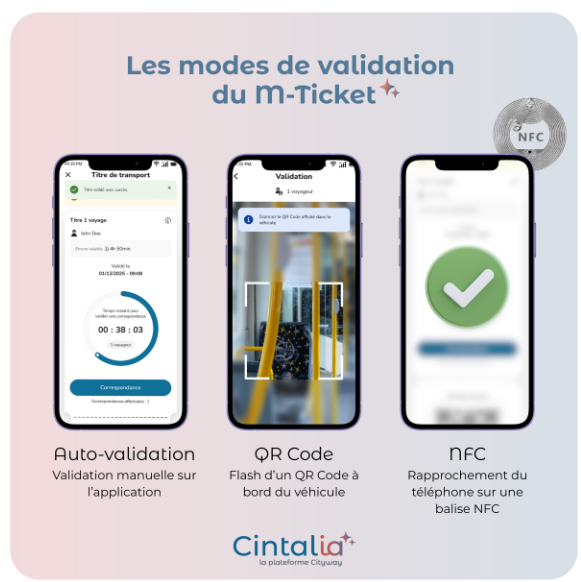
In this article, we focus on the three validation methods offered by the Cintalia Achatssolution. While other approaches exist in the public transport sector, we are presenting those that Cityway actually deploys for networks and which cover the majority of operational needs.
Self-validation, QR Code, or NFC: three possible validation methods for M-Tickets in Cintalia Achats.
A. Self-validation
The passenger opens their mobile app, selects their ticket, and manually starts a countdown timer when boarding. This validation can be displayed for inspection and also allows for managing transfers.
Pros : very easy to deploy, no onboard infrastructure required, quick activation. Cons : relies on user initiative, less onboard traceability.
B. QR Code
The passenger scans a QR code displayed on board the vehicle. The app recognizes the code and validates the ticket immediately.
Pros : simple installation (posters), precise validation traceability. Provides detailed data.
Cons : slight latency due to the time required to stop and scan the QR code, especially during peak hours.
C. NFC
Travelers simply tap their smartphone (equipped with NFC, available on most recent devices) against a contactless chip installed on board. Activation is instantaneous.
Benefits : a smooth and intuitive experience, minimal errors, and a high level of security.
Limitations : requires a compatible smartphone and the installation of onboard infrastructure.
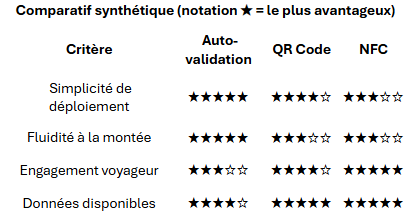
This allows you to activate the validation method best suited to your region, your onboard equipment, or your passengers' travel habits.
4. Deployment example: illygo
The illygo network invested in a passenger information solution that has been operational since 2025. Following a phased rollout strategy, the Cintalia Achats offering is being activated step-by-step, with a self-validating M-Ticket feature coming very soon to the illygo mobile app.
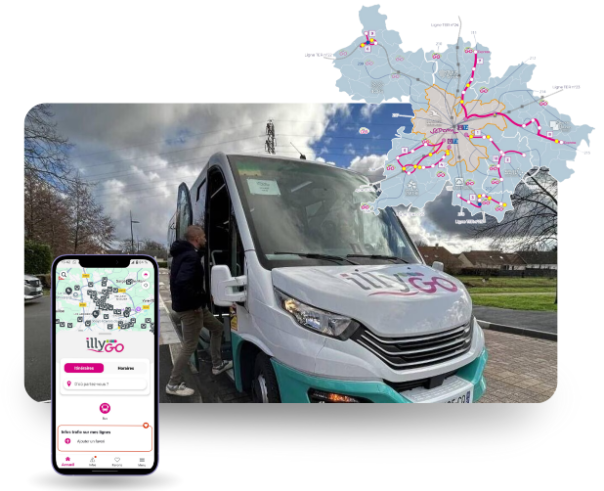
Download the IllyGO app on Google Play or on theApp Store
5. Comparing with other solutions: best practices
Rather than pitting M-Tickets against other channels, you should evaluate their interoperability with your current system. Ask yourself the right questions: Do you already have a passenger information solution? Can mobile ticketing be integrated without disrupting the user journey? Will you have to offer a second app to users? (Spoiler: avoid this)
A solution like Cintalia addresses this challenge by integrating mobile ticketing directly into a unified mobility portal (web + app).
Furthermore, to make the right choice, also consider:
- Your anti-fraud objectives (dynamic display, screenshot protection).
- Your needs for detailed statistics (validation locations, times, lines, etc.).
- Your medium-term development strategy.
6. Cintalia, Cityway's integrated mobility platform
Cintalia is Cityway's SaaS integrated mobility platform. It brings together passenger information, route planning, on-demand/PRM transport booking, user accounts, performance tracking, and ticket purchasing in a single solution.
Within this purchasing environment, mobile ticketing plays a central role: it is the feature offered by the Cintalia platform that adds a 100% mobile sales component, independent of existing ticketing systems. Mobile ticketing can be integrated directly into an existing mobile app, alongside route planning, schedules, or passenger information. Thanks to this modularity, it fits naturally into a broader application ecosystem, creating a fluid, seamless, and consistent experience for travelers.
This approach provides a unified experience, from choosing a route to validating the ticket, while ensuring operators have a simple, reliable integration that is perfectly aligned with their ticketing infrastructure.
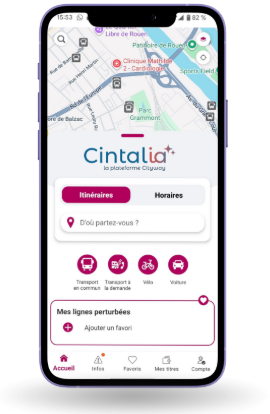
The Cintalia app: a unified experience for passenger information, routes, bookings, and purchasing and validating tickets.
7. Learn more
Interested in integrating an M-Ticket into your network?
Visit the Cintalia Purchasing
Download the detailed brochure
Contact our teams to discuss your requirements.


